SME Lending Deal Flow in the UK: How Lenders Actually Generate and Scale Originations
A practical, no-nonsense guide to building consistent lending pipelines through broker networks, marketplaces, and modern origination infrastructure.
Why Most UK Lenders Struggle With Deal Flow (And Why It’s Not a Marketing Problem)and
Here’s the uncomfortable truth: most UK lenders do not have a lead generation problem.
They have a distribution problem.
Throwing more budget at paid search or hiring more salespeople rarely fixes the underlying issue. It simply increases cost while leaving deal flow inconsistent.
In reality, lenders struggle because:
- Direct channels are expensive and increasingly competitive
- Broker relationships are fragmented and difficult to scale
- Deal flow is unpredictable and uneven
The result is familiar:
- Volumes fluctuate month to month
- Customer acquisition costs creep up
- Growth becomes operationally constrained
The lenders that scale are not the ones with the biggest marketing budgets.
They are the ones with the best access to distribution.
The 3 Ways UK Lenders Generate Deal Flow (And What Actually Works)
Most lenders rely on a mix of three channels. The difference is not what they use — it is how effectively they use them.
1. Direct Origination (Control Without Consistency)
Paid media, SEO, outbound sales — all give lenders control over lead generation.
Where it works:
- Building brand presence
- Capturing high-intent inbound demand
Where it breaks down:
- Costs scale faster than returns
- Lead quality varies significantly
- Pipelines are difficult to stabilise
Direct origination is necessary. It is rarely sufficient.
2. Broker Introductions (High Quality, Poorly Scaled)
Commercial finance brokers remain one of the most effective sources of deal flow in the UK.
They:
- Pre-qualify opportunities
- Structure deals
- Match borrowers to lenders
The upside:
- Higher quality deals
- Better conversion rates
The problem:
- The market is fragmented
- Relationships are manual
- Scaling requires time and headcount
Most lenders underestimate how difficult it is to access broker networks at scale.
3. Lending Platforms (Where Scale Actually Happens)
This is where the market is moving.
Platforms aggregate brokers, opportunities, and lenders into a single distribution layer.
What changes:
- Deal flow becomes centralised
- Matching becomes faster
- Access becomes scalable
The key shift is this:
Instead of building one relationship at a time, lenders access a network.
Why Broker-Originated Deal Flow Still Dominates (And Why That Won’t Change)
There is a persistent myth in lending that direct acquisition will eventually replace brokers.
It won’t.
Brokers sit at the centre of SME finance because they:
- Control access to demand
- Understand complex borrower scenarios
- Act as a filter for lenders
For lenders, this means one thing:
If you are not plugged into broker-originated deal flow, you are competing with one hand tied behind your back.
The challenge is not whether to work with brokers.
It is how to do it without building an unscalable network of one-to-one relationships.
The Real Problem With Traditional Deal Flow Strategies
Most lenders are still operating with distribution models that were designed for a different era.
They rely on:
- Incrementally building broker relationships
- Managing introducers manually
- Expanding sales teams to compensate
This creates a hidden ceiling.
Growth slows not because demand disappears, but because the distribution model cannot keep up.
Adding more people does not fix this. It compounds inefficiency.
The Shift: From Relationships to Infrastructure
The lenders pulling ahead are making a structural change.
They are moving from:
- Relationship-based distribution
to:
This means:
- Accessing networks instead of building them from scratch
- Standardising how deals are received and assessed
- Reducing dependency on manual processes
In other words, they are treating deal flow as a system, not an outcome.
What Is a Funding Deal Flow Platform?
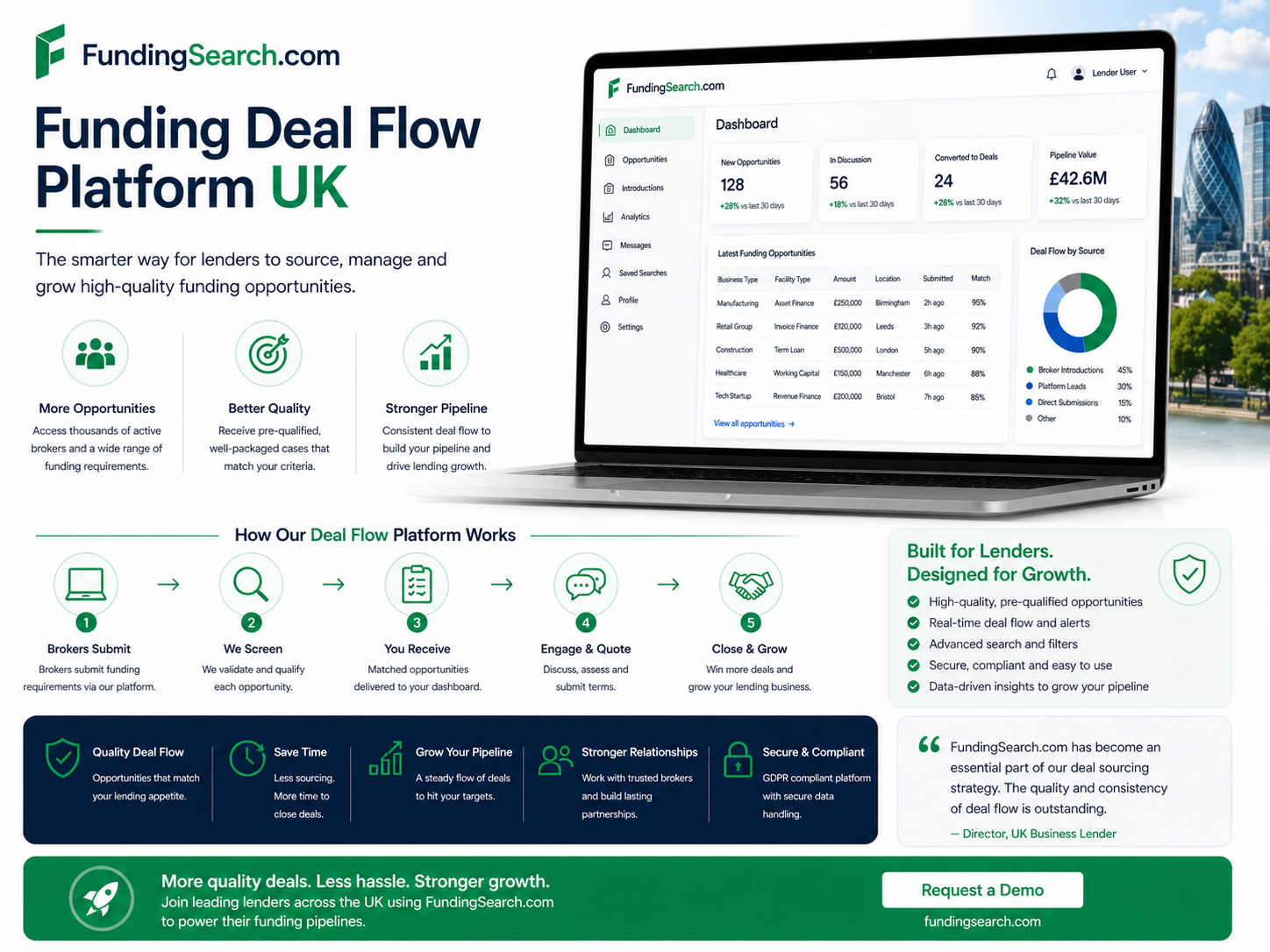
A funding deal flow platform is the infrastructure layer that connects lenders to broker-originated opportunities at scale.
It enables:
- Brokers to submit structured opportunities
- Lenders to access relevant deals
- Faster, more efficient matching between capital and demand
The critical difference is scale.
Instead of managing dozens of relationships, lenders gain access to a network of active deal sources.
How FundingSearch Works (In Practical Terms)
FundingSearch is designed to remove the friction from accessing broker-originated deal flow.
Access a Live Broker Network
Lenders are connected to an active network of commercial finance brokers sourcing opportunities across the UK.
Receive Relevant Opportunities
Deals are surfaced based on lender criteria, reducing noise and improving efficiency.
Engage and Fund
Lenders can review and act on opportunities without the overhead of managing individual relationships.
The result is not just more deal flow — it is more usable deal flow.
Why Lenders Use FundingSearch (Beyond the Obvious)
Most platforms promise more deals.
The real value is more specific than that.
Lenders use FundingSearch to:
- Stabilise origination volumes
- Reduce reliance on expensive direct channels
- Access broker distribution without scaling headcount
- Improve speed from opportunity to decision
In short:
It turns deal flow from something unpredictable into something manageable.
Who This Approach Is Actually For
Not every lender needs a platform.
But if you are:
- A challenger bank looking to scale originations
- An alternative lender seeking a consistent pipeline
- A specialist finance provider expanding distribution
Then the constraint is unlikely to be capital.
It is almost certainly access to the right opportunities at the right scale.
A More Reliable Way to Generate SME Deal Flow
Lenders do not need more channels.
They need a better way to access and manage the ones that already work.
If broker-originated deal flow is the most effective source of opportunities, the logical step is to access it in a way that scales.
FundingSearch provides that infrastructure.
Start accessing consistent SME lending opportunities through a structured broker network.
Frequently Asked Questions - Deal Flow
You control this via your lending criteria. If you're overloaded, you can increase the minimum loan size, pause product categories, or narrow geographic focus. This immediately reduces your matched deal flow. You can also discuss volume caps with our partnership team. The platform respects capacity constraints.
Yes. If a broker consistently sends unsuitable deals or exhibits problematic behaviour, you can mark them as excluded. No further deals from that broker will reach you. You can also flag specific issues with a broker to FundingSearch's partnership team for investigation.
Deal flow naturally fluctuates with economic cycles. During growth periods, SMEs seek expansion finance. During downturns, they seek restructuring finance. FundingSearch smooths these cycles somewhat by connecting diverse sectors and geographies. But macroeconomic trends do affect overall volume.
You set this. You can specify a minimum loan size (e.g., £25,000). The system won't route anything below that threshold. This ensures your underwriting effort focuses on economically viable deals. Lenders set minimums depending on their business model.
Seasonality affects deal flow somewhat. Spring often sees higher volumes (pre-summer expansion). January may see refinancing activity. But the multi-broker, multi-sector nature of FundingSearch smooths seasonal swings compared to relying on a few brokers. You'll still see seasonal patterns, but they're less pronounced.